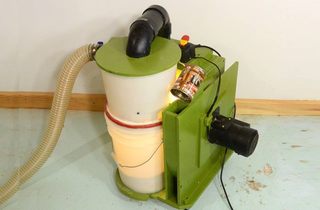
Since experimenting with the cyclone for my
small dust collector, I have been thinking more
about how cyclones actually work. What promoted this experiment
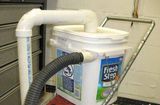
was Jim Ryan's square separator, which achieves
a surprising amount of separation even without trying to be a cyclone.
It occurred to me that if centrifugal separation activity can occur
in a square enclosure, it could also occur without any enclosure.
And that prompted me to try to produce a small sort of "tornado" in my workshop.
Maybe "tornado" is overstating it a bit, but I have from time to time seen
little eddies or twisters that pick up leaves and twigs from the ground
in otherwise relatively calm weather conditions. It's one of those that I set
out to create.
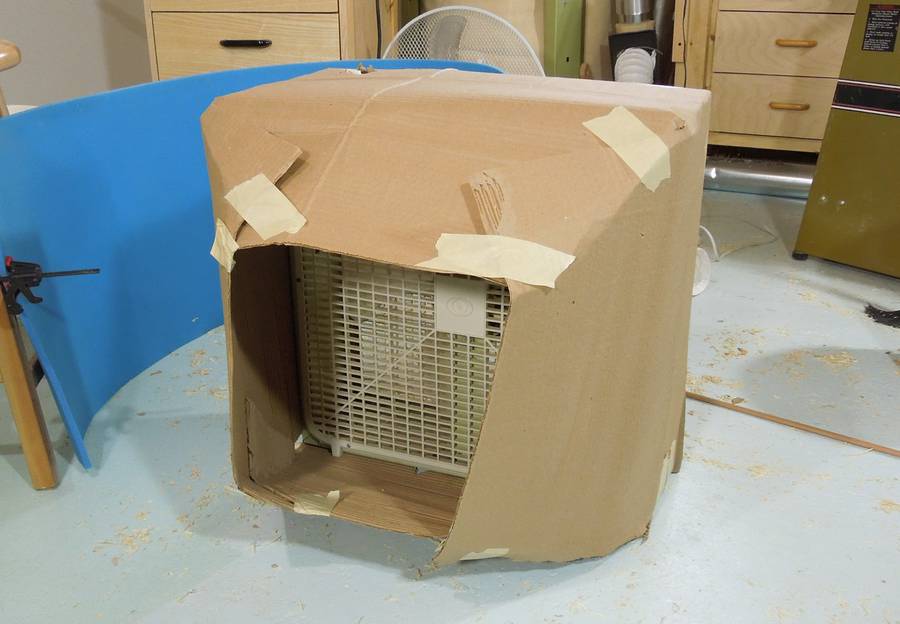
I knew I needed some suction from the top. I first tried it with just a
box fan blowing air up, but without success. I then
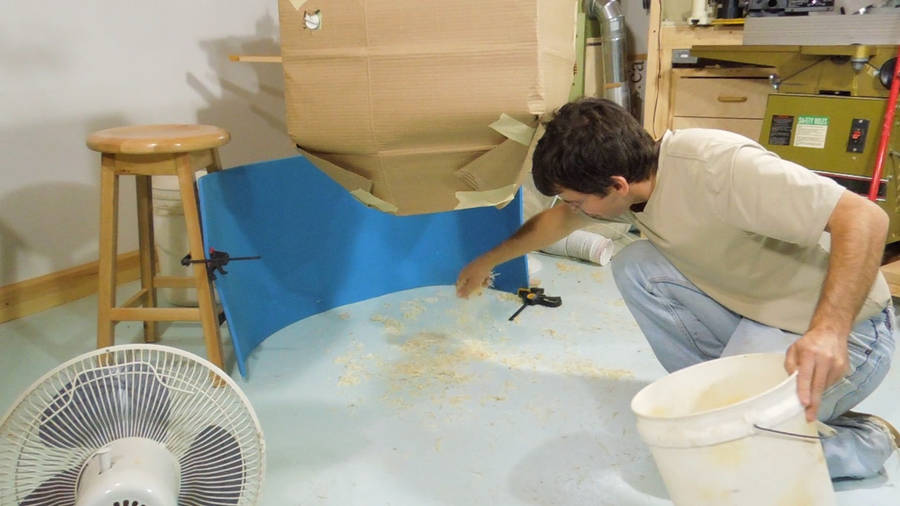
made a cardboard shroud to concentrate the suction on a smaller area.
I suspended the box fan from the ceiling, with the bottom of the shroud
about 50 cm off the floor. A second, small fan is used to give the
air a light rotation, and a blue camping mat helps to deflect that air
to make for a better initial swirling motion.
Some wood shavings spread on the floor give the tornado something to pick
up, which makes it visible.
A real tornado is visible because there is enough of a pressure
drop in the funnel to cause a temperature drop, and that in turn causes
water to condense out of the air. But my workshop tornado was not going
to be nearly as powerful.
It took some experimentation to reliably get a mini tornado out of my setup.
With my initial experiments, I tried too hard to get a strong circulating motion
on the ground by producing a sort of wind shear with two fans blowing air
past each other. But I think the strong winds from these fans
blew away any eddies before they formed.
Relatively calm air with only a light twist to
it was more conducive to forming a twister.
It's possible that I could have formed a twister without the cardboard shroud
on the box fan, but I didn't realize I had too much wind from my other fans
until after I put a cardboard shroud around the box fan.
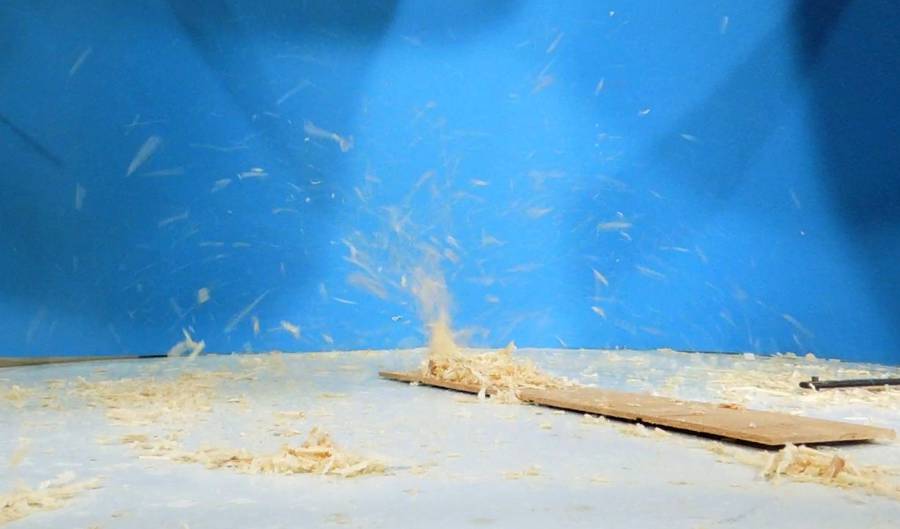
Given some shavings to pull up from the ground, the twister becomes
visible. But I wasn't successful at getting a long visible funnel.
Any debris I tried sucking up with this twister, including flour, got ejected
from the funnel before rising very far. The same is true
for a real tornado - otherwise, the debris field from a tornado would be much larger
than it is. It's condensation that makes the funnel of a real tornado visible.
What's most interesting is that the air inside the tornado is moving much faster than the
circulating breeze or the upward suction that I started with. The high airspeeds
get produced by spinning air getting pulled in towards the center. Like a pirouetting
figure skater pulling her arms in, the air also accelerates as it is pulled in.
Conservation of angular momentum dictates that, for angular momentum to be conserved, the air
must speed up as it gets to the middle. But this is counterintuitive ---
what pushes the air to go faster, and where does the kinetic energy come from?
The energy comes from the upwards suction. With centrifugal force from the spinning
air pushing outwards, pressure inside the funnel is lower than in the surrounding air.
Lower pressure is lower potential energy, and in the process
of getting to the middle, potential energy (through centrifugal force) is converted
to kinetic energy, resulting in higher wind speeds.
Or you could just use the
Bernoulli principle to explain that the air
at lower pressure moves at a higher speed.
This speeding up of air towards the middle really helps a cyclone work.
Centrifugal force on an object moving in a circular motion is given by
this formula:
F = m
V2
r
Where:
F = force (Newtons)
m = mass (kg)
V = velocity (m/s)
r = radius
To achieve maximum force on a particle of mass m, we want to maximize speed (V)
and minimize radius. And at the middle of the cyclone, r becomes smaller, while
air speed (V) increases, achieving maximum force F to pull heavier particles
away from the middle where air is sucked out of the cyclone.
And that is what makes a dust separating cyclone work so well.
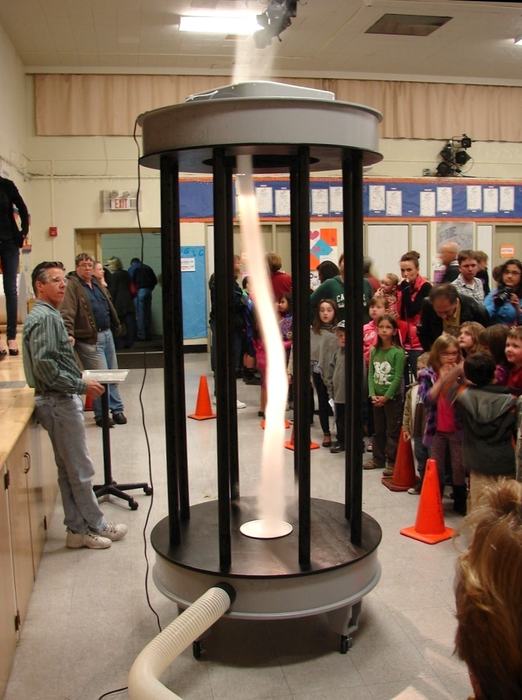
After I put this article online, Mike Meneghetti sent me a cool
picture of his tornado machine, so I just had to include it here.
Mike writes:
I made this one a few years ago. It uses a plenum at the base. Air is
sent up through the vertical pipes, each of which has holes drilled 6
inches on center. This provides the sheer wind necessary for a vortex
to form. A small fan on the top creates a low pressure area causing the
air to rise and causing the sheer wind to begin spinning. It is
illuminated by dry ice in warm water in the base. The cool thing about
this design is that spectators can reach in and temporarily disrupt the
vortex. It almost immediately resumes.
The design is not completely original. I saw the
idea on a YouTube instructional video put out by the Tornado Research
Institute. I saw some ways of improving on their concept and put them
in place.
I have been perusing your web site off and on for a few years now.
Keep up the great stuff.
Mike
 Since experimenting with the cyclone for my
small dust collector, I have been thinking more
about how cyclones actually work. What promoted this experiment
was Jim Ryan's square separator, which achieves
a surprising amount of separation even without trying to be a cyclone.
Since experimenting with the cyclone for my
small dust collector, I have been thinking more
about how cyclones actually work. What promoted this experiment
was Jim Ryan's square separator, which achieves
a surprising amount of separation even without trying to be a cyclone.

 Dangerous 1 hp leaf blower
 Fun with the Venturi effect