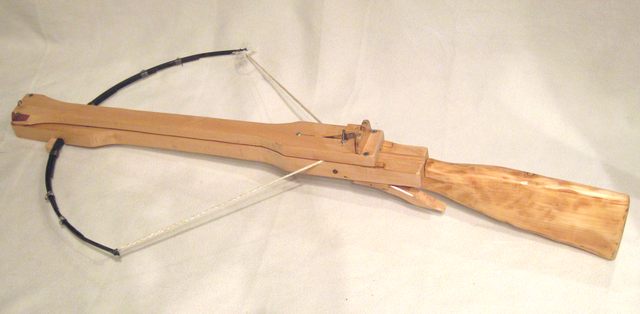
 A few months after having built my home made crossbow I had an idea
for building one that would shoot marbles.
A few months after having built my home made crossbow I had an idea
for building one that would shoot marbles.
A few months after having built my home made crossbow I had an idea
for building one that would shoot marbles.
This was in the mid 80s, when I was still a teenager living out in the country. My dad still had some narrower strips of spring steel that I hadn't used up with my other crossbow. These wouldn't be strong enough to throw an arrow really hard, but for much lighter projectiles they'd be just right.
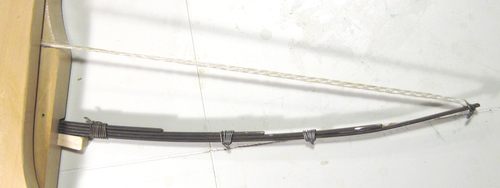 I staggered the steel bands, with one long one furthest to the front, and successively
shorter ones behind that one (a bit like leaf springs in a car). I have more bands
near the middle where the bending moment on the bow is the greatest, and just one band
extending all the way to the end which moves the fastest. The idea was to keep the
ends of the bow light, so that there would be less inertia in the bow, and thus more of
the energy is used to accelerate the marble instead of the bow.
I staggered the steel bands, with one long one furthest to the front, and successively
shorter ones behind that one (a bit like leaf springs in a car). I have more bands
near the middle where the bending moment on the bow is the greatest, and just one band
extending all the way to the end which moves the fastest. The idea was to keep the
ends of the bow light, so that there would be less inertia in the bow, and thus more of
the energy is used to accelerate the marble instead of the bow.
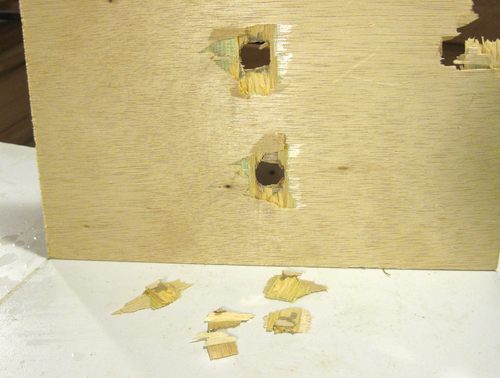 The crossbow will put a marble through the thin plywood that nectarine crates are made of
and also through 1970s style fake interior wood paneling. If I use a 5/8" steel ball
instead of a marble it will make a very clean hole in 1/4" plywood.
The crossbow will put a marble through the thin plywood that nectarine crates are made of
and also through 1970s style fake interior wood paneling. If I use a 5/8" steel ball
instead of a marble it will make a very clean hole in 1/4" plywood.
At the time that I built it (back in 1986), my options for measuring the projectile speed were very limited - basically, no media capable computers and digital cameras existed, and I didn't even have an oscilloscope. But I measured the speed of the projectile by shooting a marble up into a ball of plasticine (a sort of modeling clay). The marble became stuck in the plasticine, and I measured how high the plasticine ball was thrown up. From that, I was able to calculate its speed, and thus its momentum, and from the weight of the plasticine and the marble, I was able to calculate how fast the marble must have hit the ball to give it that momentum.
The muzzle velocity with marbles is 67 meters per second, worked out to 150 mph even (I don't use MPH normally, but I remembered that number because it's a round number). That's considerably faster than slingshots, but still only about half as fast as my marble shooting airgun that I built 17 years later.
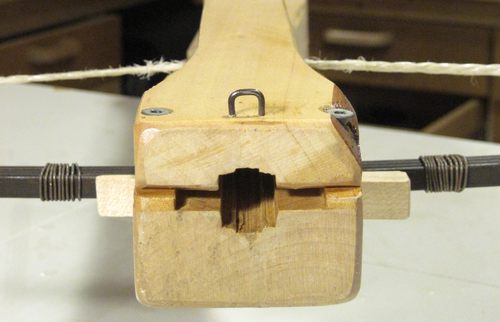 The catch with marbles is that there's no place to hook a string onto them,
so inevitably the string would jump over the marble or the marble would jump out of
the track.
The catch with marbles is that there's no place to hook a string onto them,
so inevitably the string would jump over the marble or the marble would jump out of
the track.
The solution I came up with was to have a track both above and below the marble. This kept the marble in place and also prevented the string from jumping over the marble.
I wasn't at all sure whether this would work when I started and I was surprised at the time that it actually worked. I would have used better wood if I had known that it would work when I started!
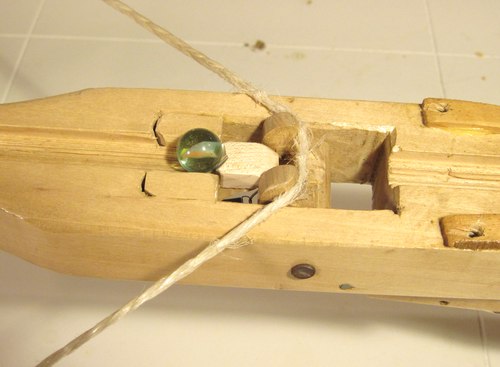 I used the same double hook as in my previous crossbow,
figuring this way I could still hook an arrow onto it. It wasn't possible to
start the marble all the way back against the string because the track that the
marble runs in didn't extend to between the hooks. But even so, there wasn't a
noticeable problem.
I used the same double hook as in my previous crossbow,
figuring this way I could still hook an arrow onto it. It wasn't possible to
start the marble all the way back against the string because the track that the
marble runs in didn't extend to between the hooks. But even so, there wasn't a
noticeable problem.
You can see the string getting frayed, as usual. I had originally used two tightly wound strands of baler twine, but didn't have any of that available last time I replaced the string. So I braided together three groups of strands from those super strong white straps that are often tied around shipping crates. The braiding really helped in that it keeps the frayed parts from separating from the main bundle. That in turn slows down further fraying.
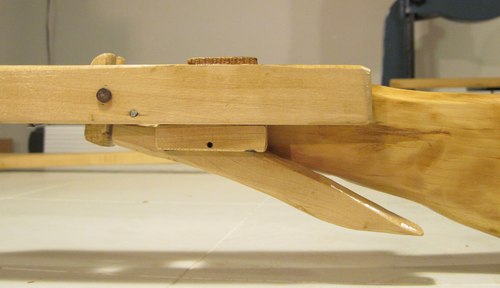 Here's a view of the hooks and trigger. The trigger is the lever near the handle. It's
pushed up to trigger. This allows the block with the hooks on it to turn counter-clockwise,
releasing the string. You can see the head of the nail that I used as a shaft for the hook
block to pivot on.
Here's a view of the hooks and trigger. The trigger is the lever near the handle. It's
pushed up to trigger. This allows the block with the hooks on it to turn counter-clockwise,
releasing the string. You can see the head of the nail that I used as a shaft for the hook
block to pivot on.
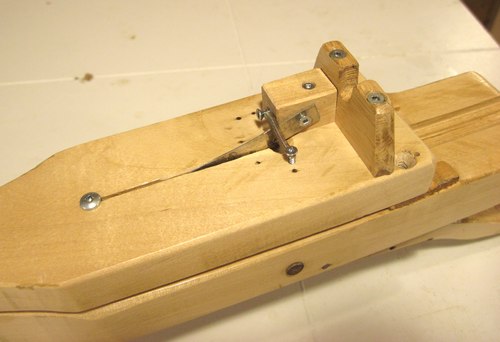 I ran into a bit of a problem whenever I was aiming at something on the ground. With the
run aimed downward the marble would start rolling and fall out the muzzle
before I pulled the trigger. So I added this strip of metal to sort of clip it in place at the
end of the track. The strip pivots on a screw and is pushed down by a spring stretched over
it.
I ran into a bit of a problem whenever I was aiming at something on the ground. With the
run aimed downward the marble would start rolling and fall out the muzzle
before I pulled the trigger. So I added this strip of metal to sort of clip it in place at the
end of the track. The strip pivots on a screw and is pushed down by a spring stretched over
it.
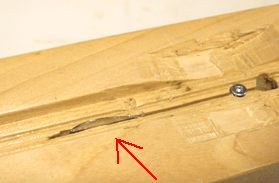 On the inside of the top track it protrudes into the track just a bit - enough to keep the
marble from rolling out. Dropping the marble down the muzzle gives it enough
momentum to overcome the friction that this bit of metal causes so that it ends up behind it.
I had to add a screw to limit the strip from coming too far down, and another
to keep it from getting thrown too far up when a shot is made.
On the inside of the top track it protrudes into the track just a bit - enough to keep the
marble from rolling out. Dropping the marble down the muzzle gives it enough
momentum to overcome the friction that this bit of metal causes so that it ends up behind it.
I had to add a screw to limit the strip from coming too far down, and another
to keep it from getting thrown too far up when a shot is made.
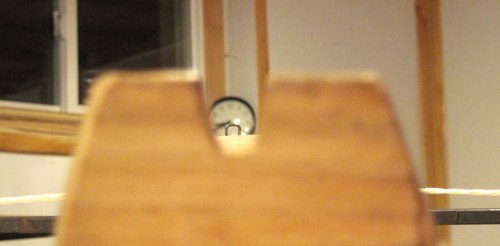 I also added a simple target sight to the crossbow. A nail, bent to the shape of a metal
arch is at the front and a notch is at the back. Aiming is done by lining up the bottom of the
notch with the inside of the metal arc at the front.
I also added a simple target sight to the crossbow. A nail, bent to the shape of a metal
arch is at the front and a notch is at the back. Aiming is done by lining up the bottom of the
notch with the inside of the metal arc at the front.
It's not nearly as accurate as the sight on a rifle, but then again neither is the crossbow, so the sight is more than adequate.

 Plastic cap shooter
 Jenga pistol
 Smashing BlackBerry
 Marble machine 2.1