A while back I received the following email from Neal Weeks:
Dear Matthias:
Just wanted to send a note that you have a great website. I just stumbled on it one day.
I'm just a hacker when it comes to building stuff. I built a wooden belt sander
that's pretty cheesy but it works for my simple things. Your free gear program is
awesome! Just started having fun with it.
Thank you for having a website that is so entertaining and educational.
I was curious about this belt sander and asked Neal for some pictures.
People have asked me to write about building a belt sander from time to time,
so I figure this project would be of interest to people.
Neal writes:
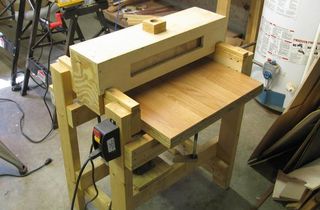
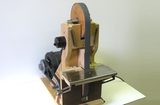
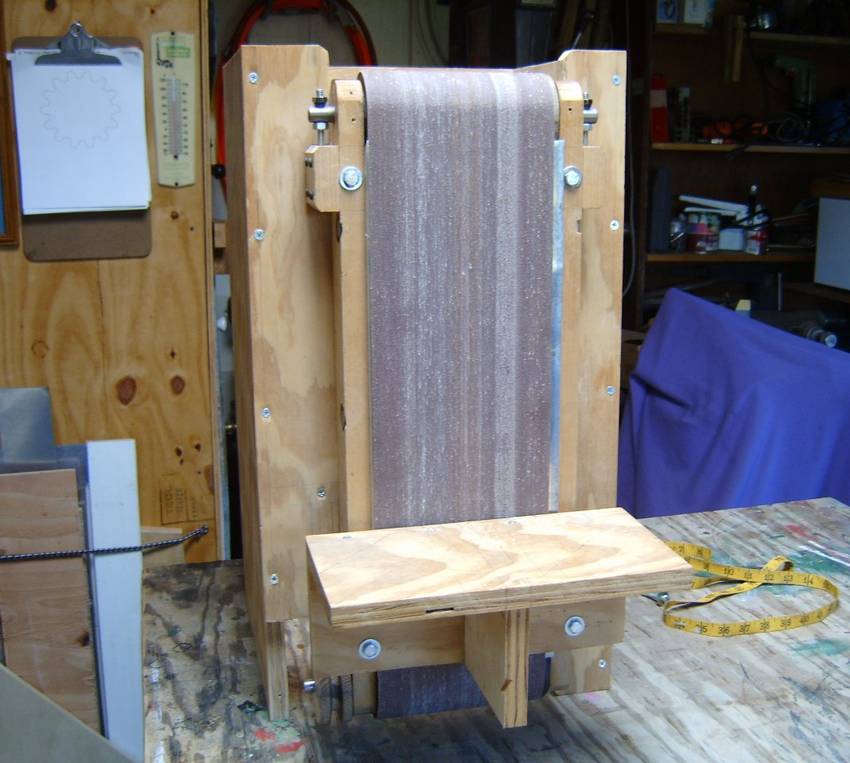
"This is my 6in x 48in sander. The box is 24in long, 12in high, and 13 1/4 wide. I can stand it up or lay it down. Both of the belt wheels are 2 and 9/16in in dia. That size worked out for the wood I had."
I asked Neal about placing the box sideways to use as an edge sander that way:
"Never tried it sideways. I think my design would be too crude for that. That is a great idea. The platform to hold the pieces could be as large or as long as the belt, if I'm understanding correctly."
(I can see one potential problem - if the motor runs on sleeve bearings, as opposed to ball bearings, running it with it's axis vertical might be a problem)
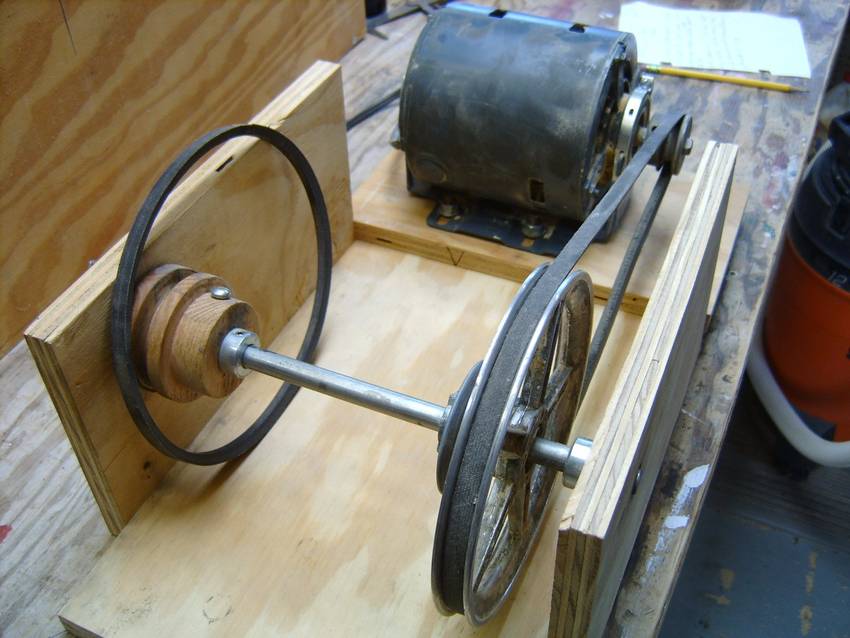
"The motor is from an old furnace blower. It is 1/4hp, 1725rpm. The bearings that I used were the less expensive ones that had a flange on one side. I used JBweld to glue them to the wood on the free spinning wheel and to glue the bearings to the frame at the drive wheel."
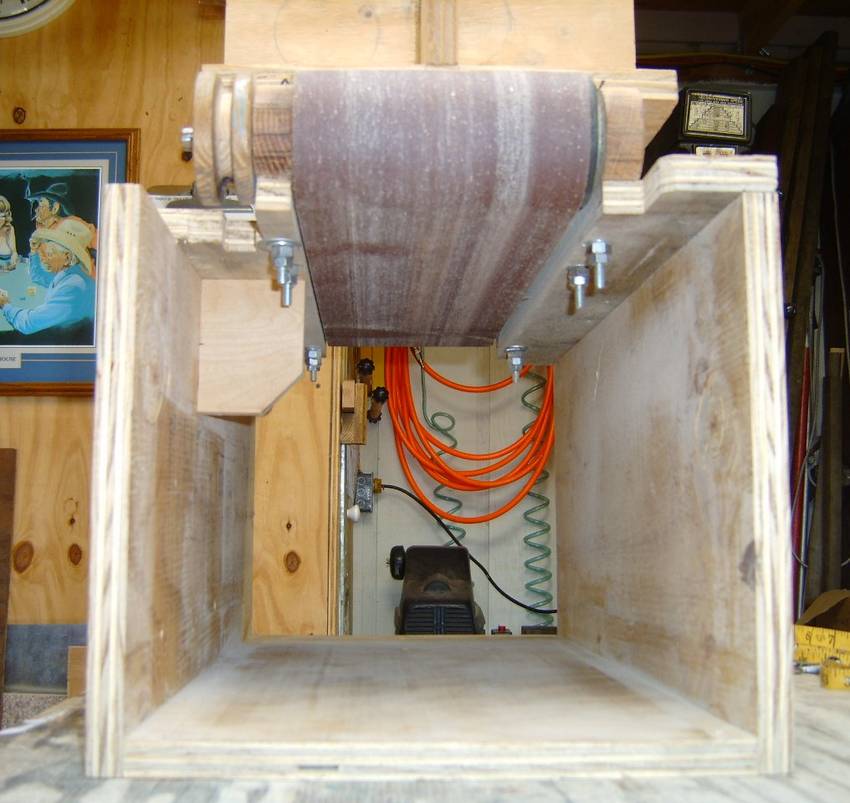
I asked Neal if he has to take the sander apart to change the belt:
"Yes, I do have to take the belt assembly apart to change the belt. The hacker that I am makes a coarse belt the best one to use."
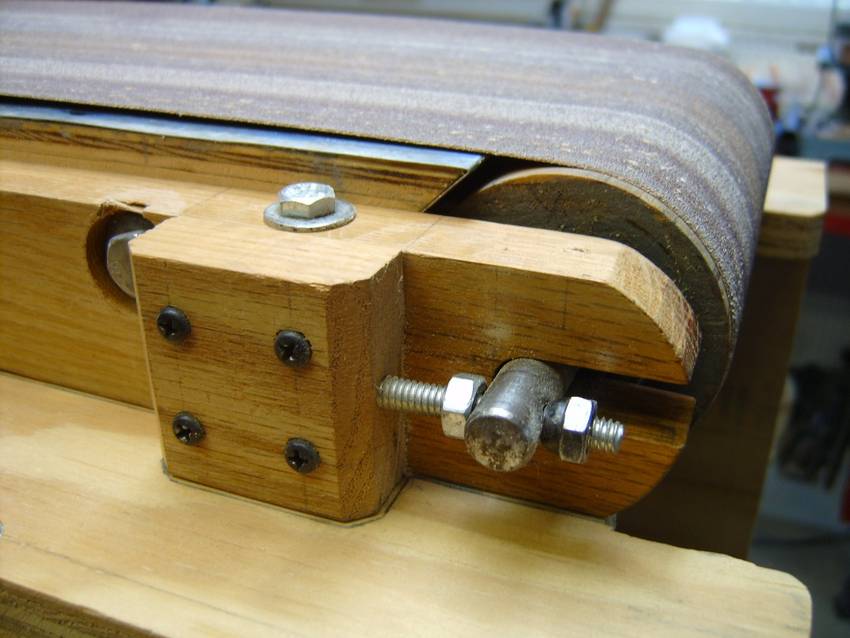
"The belt frame is oak and fascia board. Why I used giant lag screws to hold it together is beyond me. What was I thinking!!?? Oh well. I did."

"Sheet metal was used as a face on the fascia board to prevent wear. Glued it in place. I stapled bicycle inner tube to the drive wheel for needed grip."
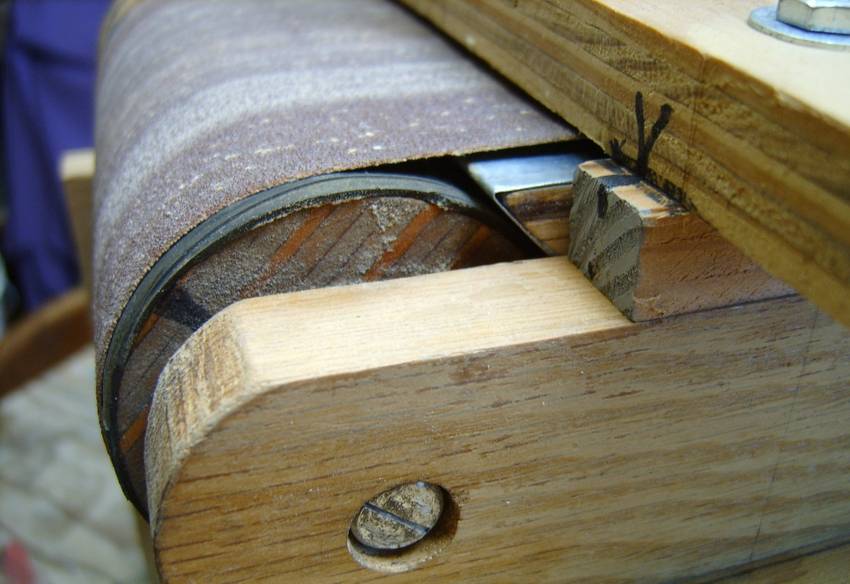
I'm always having some problems with keeping the belt tracking consistently on my belt sander (which used to be a ShopSmith accessory) So I was curious about the tracking on Neal's sander:
"My tracking kinda sucks also. I am amazed that it runs true for as long as it does. I'm sure humidity plays a part where I have to tweak it a little. I don't use it a lot but it has held up for almost 6 years!"
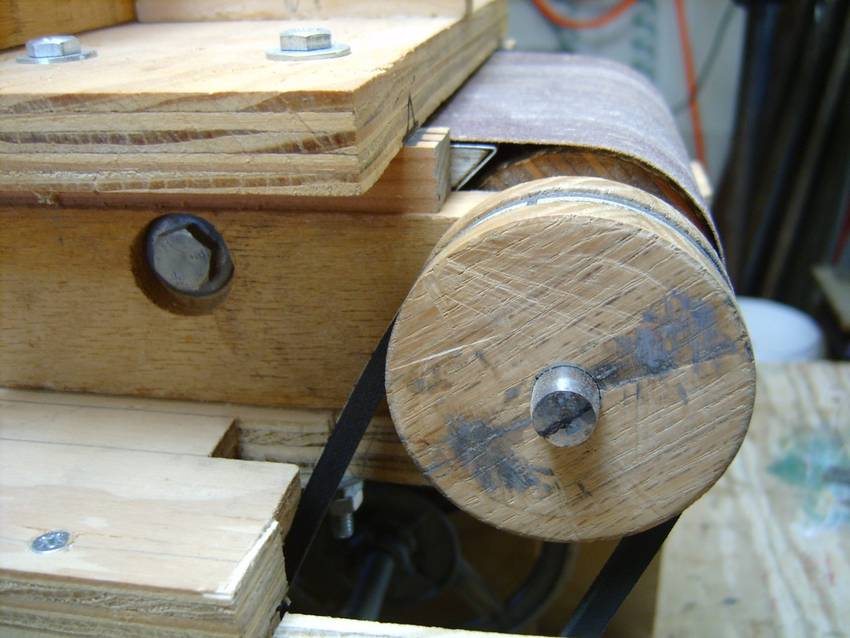
"Just for fun I made the two wooden pulleys."
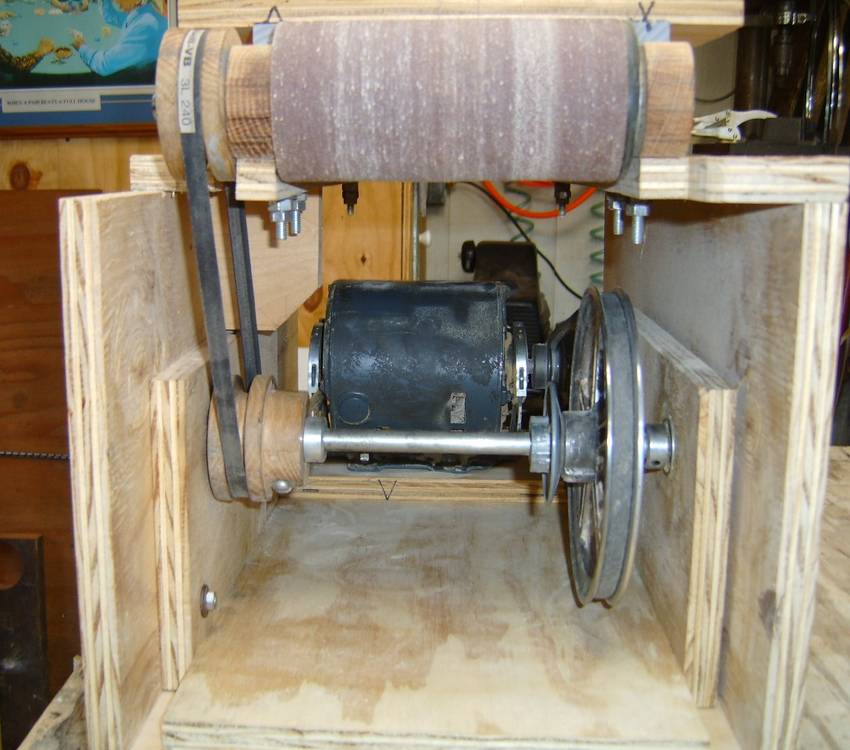
The inner carriage assembly moves to keep the drive belt tight and also to bring out for cleaning. I think the belt runs at about 500 RPM. Not sure. But it is fairly strong and can take off enough wood for me.
I would estimate the motor to large pulley reduces about 4:1, which would put it at about 430 RPM. The drive pulley has a circumference of 8 inches (20 cm), which would make the belt speed about 288 ft/m or 1.45 m/s. That's fairly low speed, but with a 1/4 hp motor there isn't enough power to run the belt really fast.
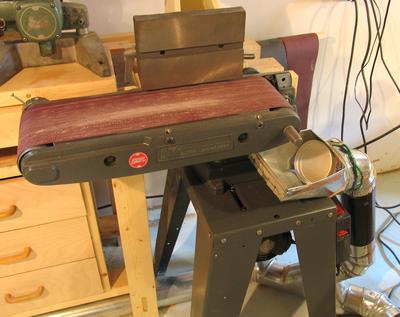 By comparison, on my belt sander, the drive wheel runs at about 1750 RPM and has a
diameter of 3 inches (7.5 cm), for belt speed of 1370 ft/m or 6.8 m/s. With a 1/2
hp motor powering my sander, I stall it from time to time - so 1/2 hp is barely adequate
at that speed.
By comparison, on my belt sander, the drive wheel runs at about 1750 RPM and has a
diameter of 3 inches (7.5 cm), for belt speed of 1370 ft/m or 6.8 m/s. With a 1/2
hp motor powering my sander, I stall it from time to time - so 1/2 hp is barely adequate
at that speed.